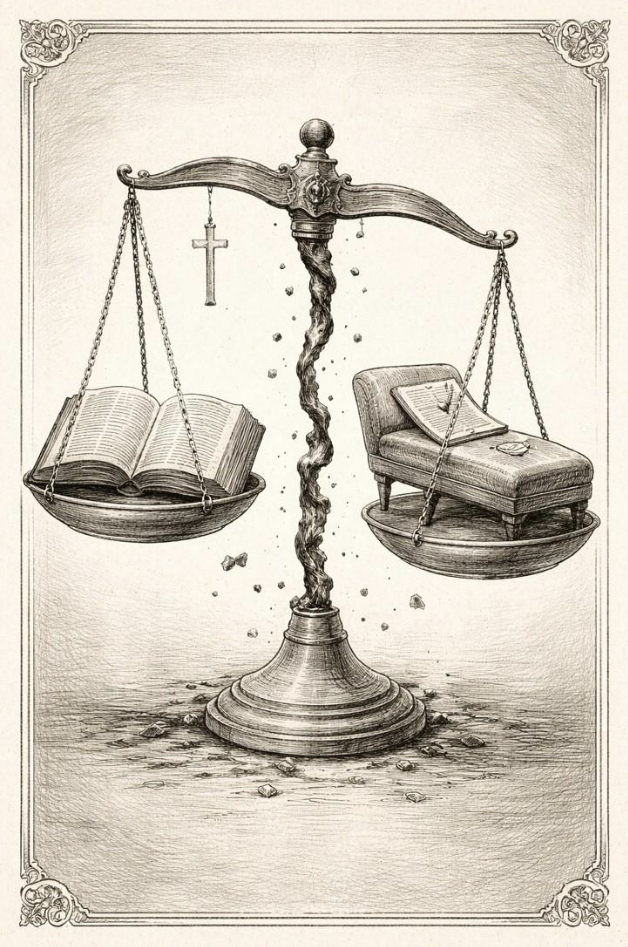
Therapy or Theology?
That’s the Wrong Question
For decades now I have felt the tug-of-war between the worlds of therapy and theology. As a pastor trained in both, I have found myself defending both to both and recommending both to both because there seems to be a weird squabble brewing between them.
Which has occasionally made me wonder if I should just start charging a referee fee.
I’ve come to realize the whole debate feels a bit like Thanksgiving dinner. There are two tables. At one table sit the theologians, pastors, and serious Bible people. This is the table that is quite certain it is the adult table and the therapists belong at the kid’s table.
At the other table sit the therapists, psychologists, and trauma specialists. This table is equally confident that it is the real adult table and that it’s the pastors who need their turkey cut into bite-sized bites.
And like most Thanksgiving dinners, each table spends a surprising amount of time talking about the other table.
At the theology table someone inevitably says,
“Therapy is replacing repentance with self-esteem.”
Another voice adds,
“Psychology keeps redefining sin as trauma.”
And before long someone mutters,
“Pretty soon therapists are going to be the new pastors.”
Meanwhile, over at the therapy table, someone inevitably says,
“The church caused half the trauma I’m treating.”
Another therapist nods and adds,
“People were told to pray about problems that actually required protection,
boundaries, and healing.”
And before long someone concludes,
“Religion often just teaches people how to suppress their emotions better.”
If you spend any time online you will see the debate everywhere.
At the theology table people warn about therapeutic deism.
At the therapy table people warn about spiritual bypassing.
One side quotes Scripture.
The other side quotes neuroscience.
One side fears therapy will dilute the gospel.
The other fears theology will ignore real human suffering.
Meanwhile everyone seems convinced the other side is quietly ruining humanity.
But here is the truth. Both disciplines are trying to understand the same human problems. They are simply looking from different angles. Both tables are trying to care for the same human soul. They are just arguing over who gets to carve the turkey.
Meanwhile the person actually struggling with anxiety, addiction, shame, grief, or relational chaos is standing somewhere between the tables holding an empty plate, wondering if anyone is going to feed them.
Which should probably tell us something. Maybe the question isn’t which table is the adult table. Maybe the real problem is that the family meal was never supposed to be divided in the first place. In fact, if these two worlds actually worked together we might see something beautiful.
Think of it like binocular vision. One eye alone gives you an image. Two eyes together give you depth. Therapy often helps us see the inner landscape of the soul. Biblical theology helps us see the larger story that landscape lives inside. The two can and should work together. Which is why I think we need to take a collective breath and chill.
Where Therapy Truly Helps
Modern psychology has given us language for parts of the human experience that earlier generations often struggled to describe. Therapists have helped us understand trauma and how the nervous system carries it, attachment and how early relationships shape our sense of safety, internal conflicts within the self, patterns of anxiety, addiction, shame, and emotional shutdown.
Can I get an amen?
For many people, therapy provides the first safe place where their inner life is taken seriously. A good therapist helps someone slow down long enough to notice what is happening inside them. They begin to recognize patterns. They start to understand why they react the way they do. They learn new ways of responding instead of repeating the same old cycle.
In other words, therapy often helps people move from confusion to awareness, and that is a massive gift to human beings. If you have ever watched someone finally understand their own anxiety, their own anger, or their own grief, you know the relief that comes with it.
The lights come on. The fog lifts. The person suddenly realizes they are not crazy. They are human. And that alone is beauty of Biblical proportions.
But therapy, for all its strengths, eventually reaches a ceiling.
Where Theology Goes Further
Psychology is very good at describing the mechanics of the human mind, but Biblical Theology tells us the story of the human soul. Therapy can help explain why you feel anxious, why you withdraw, why you sabotage relationships, or why shame follows you like a shadow. It can help you identify your patterns and understand your history.
But eventually deeper questions emerge.
- Why are we like this at all?
- Why does every human life eventually bend toward fear, pride, self-protection, and broken relationships?
- What kind of person are we actually meant to become?
Psychology offers theories and practices to relieve symptoms. But Biblical theology offers the Big Story in which we find deeper meaning and deeper healing. The Bible tells the Big Story that each of our individual stories fit in. It says that human beings were created for love, trust, and communion with God and one another. But something fractured that design, and since that moment, every human heart has been trying to manage life east of Eden by hiding, self-protecting, performing, numbing and trying to control what was never theirs to control.
But it doesn’t stop with diagnosis, just like therapy doesn’t. But it does offer more than self-help and self-actualization. It offers God-help and God-actualization into a future where every symptom will be replaced with peace and flourishing and joy and beauty, aka what the Bible calls shalom.
From Symptoms to Shalom
Instead of asking whether therapy or theology should sit at the adult table, we should ask a better question: What story best explains the human condition and the path toward healing, and how do we all work together toward that end?
In From Symptoms to Shalom, I argue that the Christian story already provides the framework we need. The Bible does not ignore human symptoms—fear, anger, addiction, shame, despair. It simply places them inside a larger narrative.
And when therapy and theology work together instead of against each other, something remarkable can happen. People can begin to move not just toward self-understanding, but toward shalom — the deep wholeness God intended from the beginning.
The goal was never to win the argument between therapy and theology. The goal has always been to help real human beings find true, lasting healing.
If you’d like to explore this conversation further, my new book From Symptoms to Shalom looks at how the Christian story makes sense of the symptoms many of us carry — and how that story leads us toward the deep wholeness of Biblical shalom.
And if you’re someone who could use a guide for the journey, I also work with pastors and ministry leaders through soul care coaching, helping people integrate faith, emotional health, and the long road of spiritual formation following Jesus on The Way.
You can learn more about both here.