Part 2 — Possession, Stewardship, and the Lie of Entitlement
What do I believe is mine—and who told me that?
Jealousy rarely begins with hatred.
It begins with an assumption—an unspoken claim, a perceived right, a quiet belief
that something (or someone) belongs to me in a way that must not be threatened.
That’s why, as we saw in Part 1, jealousy so often feels like love. It masquerades as concern, devotion, even responsibility. We tell ourselves we’re guarding something precious: a relationship, a role, a calling, a future. And sometimes we are.
But Scripture keeps pressing on an uncomfortable truth:
Jealousy turns destructive when it tries to protect what was never given to be possessed.
And here’s the grenade:
Real love requires letting go. Allowing freedom. Choice. You have to pull the
pin—and live with the possibility of the explosion of no.
Not mine.
Not wanted.
Jealousy often hides behind the language of love, but underneath it is usually self-love—love trying to protect itself from shrapnel.
God’s jealousy is different. His love always moves toward our good, even when that good costs Him grief…and flesh wounds.
Stewardship vs. Possession
Under most jealous reactions lives a simpler, sharper question:
What do I believe is mine?
Because what we believe we possess determines how we respond when freedom enters the room. Can I get a capitalistic amen? If I believe something is mine, its freedom feels dangerous. Choice feels threatening. Alternatives feel like competition.
Jealousy is what rises when love encounters freedom—and fear grabs the microphone.
This is why Scripture keeps calling us stewards instead of owners.
Possession says, “This is mine to secure.”
Stewardship says, “This is mine to receive and care for.”
Possession grips.
Stewardship holds.
Possession asks, How do I keep this from leaving?
Stewardship asks, How do I love this well—even if it’s free?
Stewardship still protects—but it protects without panic, because the steward knows two things at the same time: the thing is precious—and the thing is not ultimately mine.
The Fear Beneath Ungodly Jealousy
Ungodly jealousy isn’t mainly about anger. It’s about fear.
Specifically this fear:
If I let you choose freely, you might not choose me.
Scripture encourages honesty here. Sometimes that fear is earned.
Some of us have been betrayed.
Some of us have loved people who wandered, lied, or cheated.
Some of us learned—painfully—that freedom can hurt.
The Bible doesn’t shame that fear.
But it does expose what we try to do with it.
When Love Tries to Secure Itself
(Danny, Sandy, and the Lie of Possession)
This is where Grease becomes more than nostalgia for me.
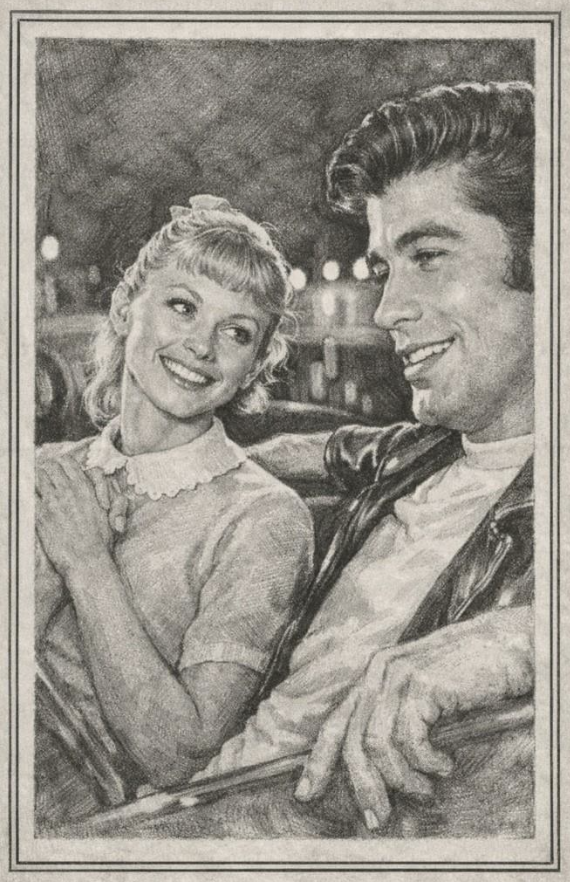
Danny Zuko loves Sandy. That much is clear. But Danny also believes something else—dangerously: If Sandy is his, then she must fit inside a version of him he can manage. A life he dreams of but isn’t willing to let go of.
At the drive-in, Sandy arrives affectionate, hopeful, open. And super cute. She’s choosing him freely. And instead of receiving that choice as a gift, Danny feels exposed. Threatened. Unstable.
Then the grabbing begins.
The posturing.
The pressure.
And even as a kid, it made me angry—because somewhere in my adolescent, made-in-the-image-of-God soul, I knew this: her trust had exposed her to something more important to him than her.
His reputation.
His image.
His standing—without her.
I think I also knew this:
Love offered freely can be withdrawn freely.
Danny doesn’t yet know how to live with that. So jealousy slips into possession.
He postures.
He performs.
He pressures.
Not because he wants Sandy—but because he wants to secure himself.
That’s the turn.
Not into rage, but into entitlement.
If you belong to me, you should make me feel safe.
If you love me, you shouldn’t challenge my image.
If you’re mine, your freedom is a problem.
When Sandy resists, Danny lashes out—not because he’s unloved, but because he feels unentitled. He loses control of the story, so he fractures the relationship instead.
That’s jealousy in its possession phase: love that tightens instead of trusts.
Enter the Golden Calf (Exodus 32)
Israel does something eerily similar.
God has been faithful—dramatically faithful. Deliverance. Provision. Presence.
And then Moses lingers longer than expected, and Israel decides freedom is too
unsettling.
So they make a god.
A god they can see.
A god they can touch.
A god they can manage.
A god who won’t surprise them, challenge them, or disappear into mystery.
In other words: a god they can possess.
Israel’s jealousy isn’t about idols competing with Yahweh. It’s about fear of a God who won’t be controlled. They don’t want a Lord. They want something predictable. Portable. Shelf-stable.
But Israel is not the only jealous one in the story.
God is jealous too.
And His jealousy is not insecurity. He is not pacing heaven saying, “Please don’t like them more than Me.” His jealousy is covenant love—the holy grief of a Husband who knows the calf will hollow them out.
And so here’s the dividing line:
Fleshly jealousy says,
“I must limit your freedom to secure my security.”
Godly jealousy says,
“I want your love freely—and I will tell you the truth about what will destroy
you, and I know what you might choose, but I will wait for you to come
back.”
Scripture Never Gives Us Absolute Ownership
“The earth is the LORD’s and the fullness thereof.”
(Psalm 24:1)
We are given responsibility, not possession.
Stewards, not owners.
Gardeners, not landlords.
Children are heritage, not property.
Gifts are received, not seized.
Callings are assigned, not earned.
Even breath is borrowed.
Jealousy turns toxic when stewardship mutates into entitlement—when we guard what was never entrusted to us.
That’s how love becomes brittle.
That’s how freedom feels like betrayal.
That’s how fear masquerades as devotion.
God’s Jealousy Is Not Afraid of Freedom
“I have redeemed you; I have called you by name, you are mine.”
(Isaiah 43:1)
God can say mine because His love is not threatened by freedom.
He creates humans with choice.
He covenants knowing they can wander.
He loves Israel knowing they will resist Him.
He comes in Christ knowing He will be rejected.
And He does not revoke freedom to protect Himself.
“He who keeps Israel will neither slumber nor sleep.”
(Psalm 121:4)
God guards without gripping.
He protects without coercion.
He waits without panic.
His jealousy is not anxious.
It is patient.
Steady.
Utterly secure.
God’s jealousy is what love looks like when it doesn’t need control to survive.
A Better Way Forward
If Part 1 explored jealousy’s instinct, Part 2 presses deeper:What do I fear would happen if what I love were truly free?
And beneath that:
Am I trusting love—or trying to play God?
Jealousy doesn’t need to be crushed.
It needs to be converted.
From fear into faith.
From possession into stewardship.
From control into covenant.
In Part 3, we’ll look at what jealousy produces when threatened—rivalry, resentment, and the strange pleasure of watching others fall. And how covenant becomes the cure.
Until then, remember this:
Wanting security doesn’t make you weak. But jealousy is a terrible savior.
It promises safety
and delivers slavery.
God’s jealousy is different.
It loves without fear—
and invites us to do the same.