The Good-er Gospel
It’s Bigger Than the Cross
Most Christians I know can tell you the gospel in two sentences:
We sinned. Jesus died for us because of it.
Glory hallelujah. Amen and amen. That is gloriously true!
But it is also—if we’re honest—sadly incomplete.
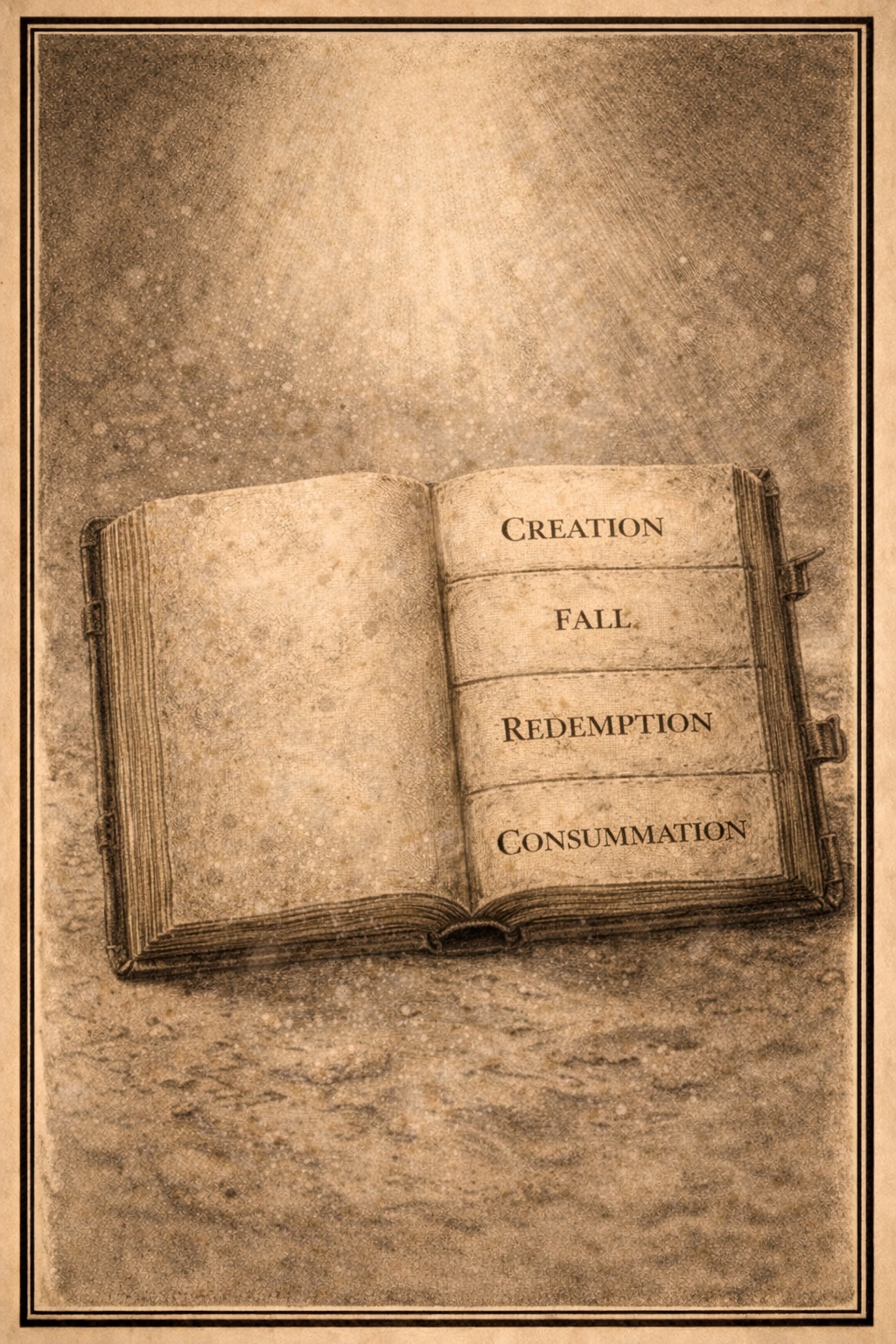
The Christian story of life is not a two-sentence explanation of personal salvation. It is a four-chapter story of the world, of us, and of what God is doing. The chapters are simple enough to memorize:
- Creation
- Fall
- Redemption
- Consummation
But when the story is reduced to the middle two chapters—Fall and Redemption alone, as many Christians assume and too many pastors preach—we end up with a “Gospel” that saves souls but shrugs at the world, our ongoing work and suffering, and what we can genuinely hope for. The “Gospel” remains good news. But it misses the good-er news God has for us.
We forgive sin but don’t know what to do with bodies.
We preach grace but struggle to name goodness.
We talk about heaven but seem oddly indifferent to earth.
And resurrection—if we’re honest—quietly becomes a metaphor rather than a
future.
The problem isn’t what we’re saying.
It’s what we’ve left out.
Scripture doesn’t tell a two-chapter story. It tells a four-chapter one—and every chapter matters if we want to see clearly, live faithfully, and hope honestly.
The World as God Intended It
The Bible doesn’t begin with a problem.
It begins with a gift (Genesis 1–2).
Before sin, before shame, before rescue plans and redemption language, there is a declaration that rings out like a drumbeat through the cosmos:
This is good
Creation tells us that the world was not born broken. Matter is not a mistake. Bodies are not liabilities. Work is not a curse. Culture is not a distraction. Pleasure is not suspicious. God delighted before He rescued—and out of that delight, He created.
When Christians skip Creation, they don’t just lose theology; they lose purpose and joy.
They lose their moral compass too. They can name sin but not goodness. They know what’s wrong but not what’s right. They spend their lives avoiding evil instead of cultivating beauty. Creation gives us dignity before morality, because we are made in the image of God. It gives us belonging before behavior, because we are made for communion—with God and one another. It gives us vocation before obligation, because we are made to work and to keep—with joy, not resentment.
Creation answers the question underneath every ethical, cultural, and pastoral
debate:
What was this for in the first place?
What Went Wrong Without Erasing What Was Good
The Fall explains why the world feels both familiar and hostile, beautiful and brutal. It gives us realism—and if we’re paying attention, humility—without despair. (Genesis 3; Romans 7:15–25).
When man and woman first sinned, it did not merely introduce guilt. It ignited a war between good and evil that we are still living inside. We didn’t just break a rule; we fractured a relationship—and the shockwaves are still rippling through history.
Sin is not merely rule-breaking; it is a rupture—with God, with one another, with ourselves, and even with the ground beneath our feet. But crucially, the Fall does not erase Creation. The image of God is wounded, not deleted.
When Christians over-center the Fall, everything becomes suspect. Desire becomes dangerous. Power becomes poison. Institutions become irredeemable. The world is treated like a sinking ship instead of a battlefield God is reclaiming.
The Fall tells us why things are hard.
It does not tell us that things are hopeless.
Redemption: God Refusing to Abandon His World
Redemption is not God giving up on Creation.
It is God refusing to let it go. (Isaiah 65:17–25; 2 Corinthians 5:21).
At the cross, something was finished once and for all. Sin was dealt with. Death
was defeated. The verdict was rendered.
And yet, the story did not stop there.
The finished work of Christ becomes the ongoing work of the Spirit, applying, unfolding, and extending that victory into every corner of life. Jesus does not arrive to extract souls from earth to a land of clouds and harps. He comes to reconcile all things—things in heaven and things on earth. (Colossians 1:19–20)
Forgiveness is real, personal, and essential.
Grace still shocks. Mercy still heals. The cross still stands at the center.
But it stands there not as an escape hatch—rather as the turning point of
history. Redemption means God is already at work restoring what was lost—often
slowly, often quietly, often through very ordinary faithfulness, powered by an
extraordinary Spirit.
And that the consummation of that work is not in doubt.
Consummation: Where Everything Is Going
This is the chapter most Christians barely know exists, much less how to talk
about.
And some talk about it confidently—without the faintest idea what is actually
promised. (Revelation 21–22).
The end of the story is not souls floating away to heaven. It is heaven coming home to earth. A new heavens and a new earth. Not a do-over. These heavens and this earth made new. Fully restored. Bodies raised. Justice completed. Creation healed. Tears wiped. Love made permanent.
Without Consummation, resurrection only makes sense for Jesus.
Why raise our bodies if bodies don’t matter?
Why heal our creation if creation will be discarded?
Why practice justice now if God won’t finish it later?
Consummation tells us why our work matters. That there is continuity between the
now and the not-yet. What we do is not erased; it is redeemed and woven into the
mission of God.
Why All Four Chapters Change How We Live Right Now
When you live inside the whole story, your daily life finally starts to make sense. This is where theology stops floating and starts walking.
Creation teaches you to receive the world with gratitude instead of suspicion. You care for bodies. You steward resources. You honor beauty. You treat work as meaningful rather than merely necessary. You stop apologizing for being human.
The Fall keeps you sober without making you cynical. You expect resistance, failure, and disappointment—without being shocked by them or crushed beneath them. You repent quickly, stay humble, and fight evil without hating the world—or the people—God still loves.
Redemption reminds you that forgiveness is not optional or peripheral—it is central and freeing. You are released from shame, freed from striving, and unburdened from the exhausting illusion that everything depends on you. You can rest inside a redemption story far bigger than your little corner of control.
Consummation anchors you when obedience feels costly and fruit feels scarce. You endure suffering without surrendering hope. You work for justice without needing to see the final outcome. You live as if nothing done in love is ever wasted—because it isn’t.
The Gospel is not smaller than we thought.
It is larger, deeper, and far more demanding.
And—thanks be to God—far more beautiful.
Definitely good-er.
This Is The Way
This four-chapter story is not just theology I believe—it is the path I walk, and the path I invite others to walk with me. It is why my practice is called The Way Soul Care.
“The Way” is not a technique, a brand, or a shortcut. It is the name the earliest Christians gave to the followers of Jesus. And it fits—because the Gospel is not merely something to agree with. It is a way of seeing, a way of living, and a way of healing.
At The Way Soul Care, we take this whole story seriously. We honor Creation, helping people recover dignity, desire, embodiment, and joy. We tell the truth about the Fall, naming sin, suffering, trauma, and disorder without shame or denial. We rest deeply in Redemption, trusting the finished work of Christ and the ongoing work of the Spirit to bring real change. And we live toward Consummation, cultivating hope, courage, and faithful presence in a world God has not given up on.
If you feel tired of half-stories that can’t carry the weight of real life…
If you long for faith that speaks to your body, your work, your grief, your
hope, and your future…
If you want to learn how joy, meaning, beauty, and deep transformation actually
fit inside it
Then I’d be honored to walk The Way with you.
Because this—this whole story—is the Gospel.
And it is very, very good-er news.