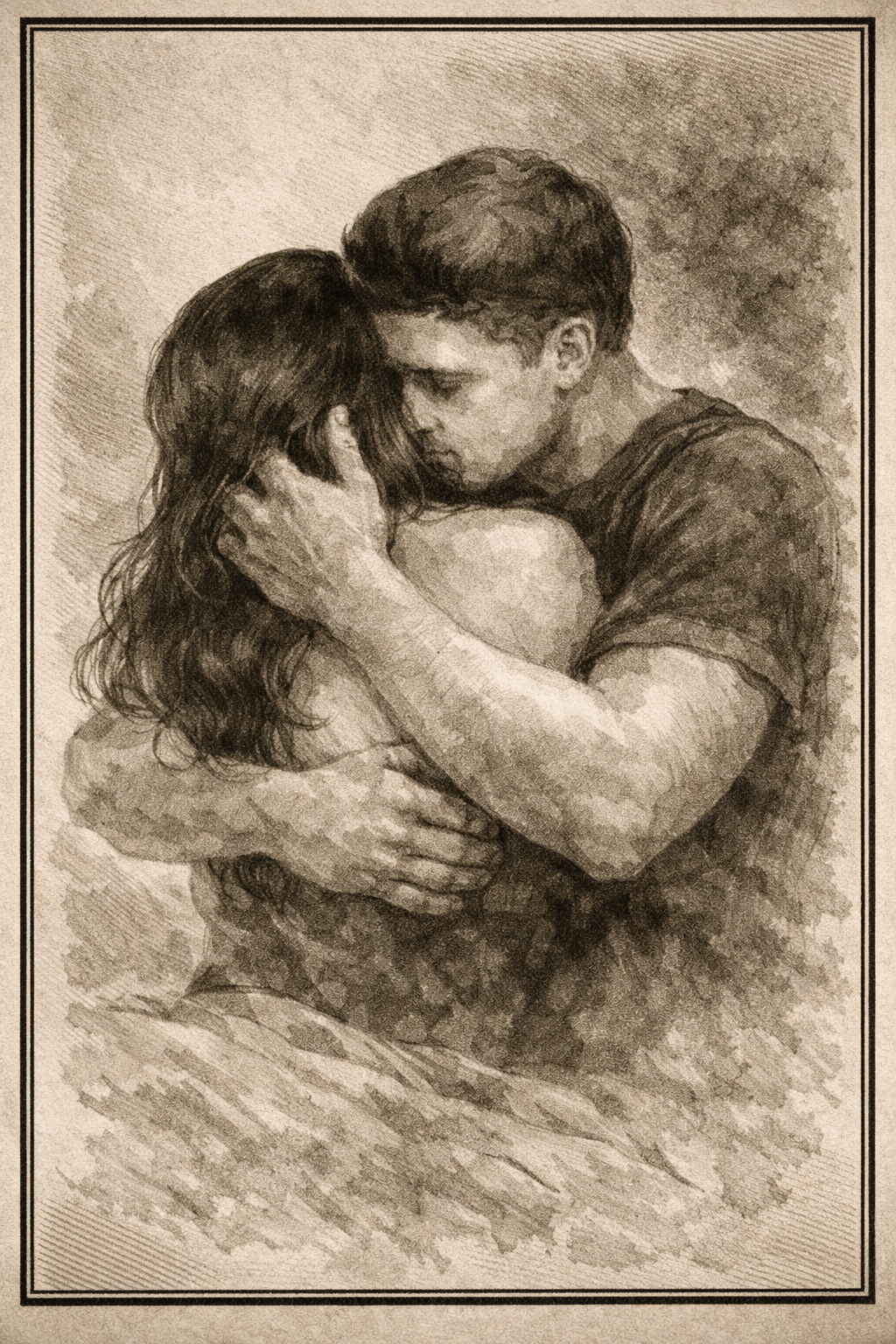
This article opens a series exploring why therapy, with all of its benefits, must sit beneath theology, not above it—because the soul was God’s territory long before it became the domain of clinicians.
Before therapy first named “attachment,” before psychologists mapped the nervous system, before we learned to talk about “dysregulation,” Scripture had already spoken a truer, deeper word:
It is not good for man to be alone.
(Genesis 2:18)
This is not a clinical observation. This is a creational decree. God declaring—from
His own heart— that humans are made to live in covenantal communion.
Which means
this: what modern therapists call “regulation,” the Bible calls abiding, cleaving,
sheltering, and being held by God.
Our emotional instability is not primarily a nervous-system malfunction—it is the
ache of a soul separated from its First Love.
Our frantic scrambling for comfort
is
not merely an attachment wound—it is the long echo of Eden, the memory of communion
lost.
We Were Made for Communion, Not Self-Regulation
Self-regulation is a modern virtue. Pull yourself together. Breathe. Ground. Cope.
Manage. Biblically, this is foreign. Not wrong—just insufficient. Adam did not need
coping strategies. He needed companionship. He needed God walking with him in
the cool of the day. (Genesis 3:8)
He needed Eve, bone of his bone, flesh of his flesh. (Genesis 2:23)
What the modern world calls “regulation,” Genesis simply calls presence. We are stable when we abide. We are steady when we cleave. We are whole when we dwell with God. Abide in Me.(John 15:4–5)
Every person—married, single, anxious, confident—will instinctively reach for something when the soul trembles. The Bible does not call these “regulators.” It calls them refuges.
And Scripture is blunt about false ones:
Some trust in chariots and some in horses…
(Psalm 20:7)
Their idols are silver and gold…
(Psalm 115:4)
Woe to those who go down to Egypt for help…
(Isaiah 31:1)
Broken cisterns that hold no water…
(Jeremiah 2:13)
Work becomes a refuge. Money becomes a refuge. Porn becomes a refuge. Achievement, affirmation, busyness—all refuges. We were designed to seek shelter. The psalms paint the alternative:
You are my refuge… my fortress… my hiding place.
(Psalm 46:1, 32:7, 91:2)
That isn’t therapy.
That’s covenant.
Marriage Is Meant to Be a Human Home of Covenant Communion
The biblical language is richer than therapy-speak: to cleave is to become one life, one flesh, one shared shelter. A covenantal communion where souls are steadied by mutual presence under God. And here is the pastoral truth I’ve watched unfold for decades: when the marital communion is weak or absent, the human heart will instinctively turn back to its old refuges— parents, career, pornography, pets, perfectionism, addictions, spiritual substitutes.
Because communion must go somewhere.
I once counseled a couple married twenty years, bewildered by their emotional
distance. Eventually the simple truth emerged: she talked to her mother every single
day— not as a daughter relating to a mother, but as a soul seeking her primary
refuge. Her mother was her sanctuary. Her emotional home. Her first love.
And as long as that was true, she could never fully cleave to her husband. The
marriage had no room to breathe and no foundation upon which to build trust. They
were not violating attachment theory—they were violating Genesis.
When We Cleave to Someone Who Cannot Carry Covenant
There is another grief that must be named: not just the heartbreak of
failing to
cleave,
but also of cleaving to someone who cannot hold covenant at all.
Covenant in
Scripture is not sentiment or compatibility.
It is safety—steadfast love
within
sacred boundaries, a refuge shaped by fidelity, truth, sacrifice, and mutual
honoring.
It is the core reality that makes the “naked without shame”
vision for marriage possible.(Genesis 2:25)
So when a person cleaves to someone who is emotionally unavailable, unfaithful,
unsafe, manipulative, or so wounded they cannot live in covenant…the soul suffers a
collapse.
You run to a person for shelter—but instead of steadiness you find chaos. Proverbs
calls this “trusting in a broken tooth or a foot out of joint.” (Prov.
25:19)
Covenant is meant to say: “You are beloved. You are safe. You are mine.” Broken
covenant whispers: “You are not enough. You must earn love. You are alone even when
married.”
You cleave because you believe God made covenant good. So when it breaks, the soul wonders: “Did I misunderstand God? Is covenant itself broken?” This is why Scripture reveals God as the Husband who cannot fail:
I will betroth you to Me in faithfulness.
(Hosea 2:20)
I will never leave you nor forsake you.
(Hebrews 13:5)
Though my father and mother forsake me, the Lord will take me in.
(Psalm 27:10)
The call for every spouse is covenant faithfulness. And if you aren’t faithful, you are violating your own creational mandate and a conduit of the fall, a conduit of sin, a conduit of dysfunction. But the reality is that human covenant can be shattered—but divine covenant does not crack. And a wounded heart can only learn to cleave again when it first rests in the One who never breaks covenant at all.
A Word to Parents: The First But Not Last Sustainers of Communion
This is where good parenting becomes gospel-shaped: the goal of parenting is not lifelong emotional fusion; it is lifelong faithfulness that releases children to cleave elsewhere. To raise a child who depends on you forever is to keep them from the very design God wrote into creation.
Deuteronomy called Israel to teach their children diligently—but not to keep them bound forever. (Deut. 6:6–7). If we cling too tightly to our children, we are not honoring covenant—we are blocking it. We must honor our children’s call to leave and cleave and if we don’t, chances are we are depending too much on them for the regulation we should be finding in God or our spouse.
A Word to the Single: Communion with God Is Not Second-Class
Marriage is one expression of covenantal communion, but it is not the only one.
Paul—single—called God his “comfort in all affliction.” (2 Corinthians 1:3–4)David—often alone—called God his portion and cup (Psalm 16:5) and his shade at his right hand. (Psalm 121:5)
Jesus—unmarried—lived in perfect union with His Father.
Therapeutic culture says singles must find a “regulator.” Scripture says: You already have a Refuge. You already have a Covenant Partner. You already have communion.
And that communion is not emotional management—it is worship, belonging, identity, abiding, and the indwelling Spirit. Yes, you were made to have His covenant faithfulness mediated through a human conduit and if you don’t have that, it can and should be grieved. But God is not a second-class alternative. Never has been. Never will be.
The Gospel Is God Restoring the Lost Communion of Eden
If we translated attachment theory into biblical language, the whole story would look like this:
- Creation – God creates a covenant partner for communion. (Genesis 2:24)
- The Fall – humanity breaks communion and runs to false refuges. (Genesis 3:18-24)
- Idolatry – the heart cleaves to broken cisterns. (Jeremiah 2:13)
- The Gospel – God restores communion through the Bridegroom. (Ephesians 5:25–27)
- The Spirit – God dwelling within us as our abiding presence. (John 14:16–17)
- The Church – the family of redeemed communion. (Acts 2:42)
- Marriage – the living icon of God’s covenant with His people. (Ephesians 5:31–32)
The gospel does not promise perfect nervous systems. It promises reconciliation with God, communion restored, and the steadying presence of a Love that does not break. When the soul finds its refuge in God, marriage becomes communion instead of compensation, singleness becomes fullness instead of lack, and idols lose their power because the heart is finally home.
If your relationships are struggling and want help, click on the “Get Started” link above and schedule a free 30 minute consultation call to see if I might be able to help restore the sanity…and the communion…you are made for. I am trained therapeutically and I love it. But I love Jesus more and know that walking on “The Way” is at the center of healing, peace, and joy.