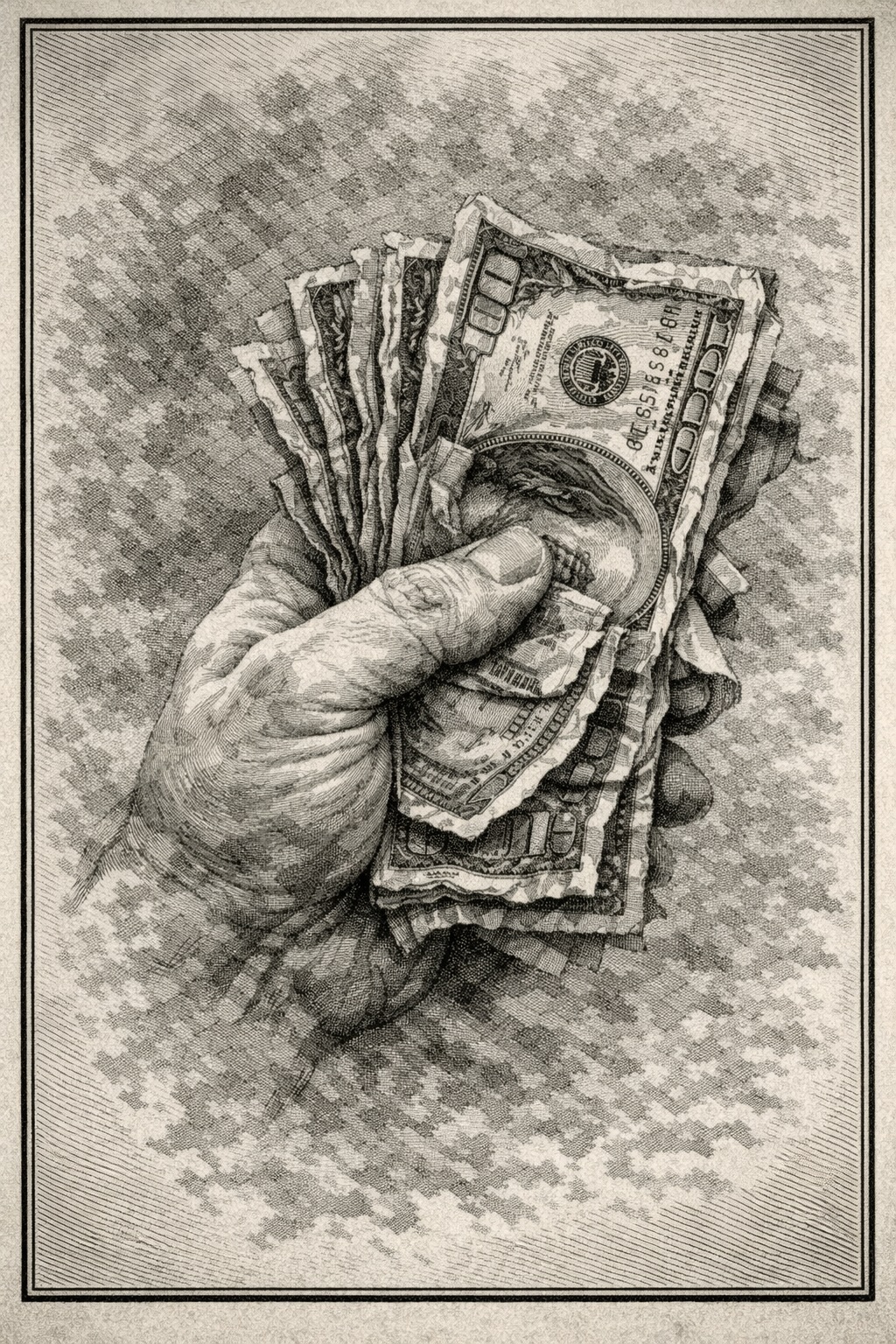
We Should All Die in Debt
(Relax, Dave Ramsey—not the financial kind.)
I’ve been thinking lately about how much energy we spend trying to tidy up our relational books the same way we tidy up our bank accounts. Pay off every emotional debt. Square every ledger. Keep the scales perfectly balanced. There’s something in us that wants to live “in the black” relationally.
In one sense, this impulse reflects a God-given desire for justice. But Jesus doesn’t want us to balance our relationships like budgets. If anything, He invites us to carry a debt—a debt that grows deeper and deeper as we age. Paul says it bluntly in Romans 13:8
Romans 13:8
Let no debt remain outstanding, except the continuing debt to love one another.
In other words: die in debt. On purpose.
We treat love like currency—give affection, expect appreciation; offer help, hope for gratitude; sacrifice, anticipate reciprocity. Yes, there is often an immediate earthly return for our acts of “love”, but if we invest them expecting an immediate, tangible return, we will most often be disappointed. Christ-like love isn’t an emotional stock market. It’s not a barter system or a “get rich quick” strategy. It’s a gift economy—lavish, unreasonable, cross-shaped. And it should expect little to no earthly return. Not applause. Not fairness. Not closure. Not even comprehension.
Before anyone weaponizes that, let’s be clear: love does not enable wickedness, injustice, disobedience, or laziness (parents, can I get an ‘Amen’?). Jesus forgave sinners *and* flipped tables. Real love sometimes corrects. Sometimes confronts. Sometimes redraws boundaries with a holy Sharpie. “Speaking the truth in love” is not code for “be permissive”—it’s code for “be like Christ,” even when that costs something.
What “Dying in Debt” Actually Looks Like
For years in counseling and pastoral conversations, I’ve asked a simple question that cuts right to the heart:
“Am I giving here in order to get something back?”
Most of us—married, single, widowed, dating, complicated, “don’t ask”—run that calculation constantly. *Is this fair? Am I being appreciated? Am I the only one carrying this?* But real love doesn’t wait for equal exchange.
So what does “dying in debt” look like in the real world?
- Doing the dishes again without judging, even though you did them yesterday and yesterday didn’t thank you.
- Listening to a story you’ve already heard, because the heart behind it is more important than the plot.
- Initiating forgiveness first without self-pity, even when you weren't the villain.
- Being the emotional adult when everything in you wants to be petty, spicy, or Instagram-story vague.
- Showing up—to the grief, the silence, the awkwardness, the stress, the long argument that keeps recycling itself like a sitcom rerun God keeps putting into syndication just for you.
- Navigating multicultural confusion with humility that says, “Help me understand your world,” instead of, “Why aren’t you doing this like me?”
- Serving in your church without a spotlight—stacking chairs, giving rides, teaching a preschool class where nobody listens and the goldfish crackers are older than the Old Testament.
- Standing with the poor when they can’t repay you—sitting with the addicted, delivering groceries to a family who won’t remember your name, investing in people who can’t “give back.”
- Bearing someone’s emotional weather—cloudy, stormy, unpredictable—not because you enjoy it, but because Christ bore with you long before you bore any fruit.
THIS is dying in debt.
THIS is Kingdom accounting.
THIS is grace in the everyday trenches.
THIS is The Way.
Whenever we barter with “love”—*I’ll give if you give, I’ll soften if you show effort, I’ll stay engaged if you earn it, I’ll serve if you applaud, I’ll forgive if you balance your part*—it’s not love at all.
Christ-like love, by definition, carries no conditions. Grace has no fine print. Mercy doesn’t negotiate. Agape doesn’t keep receipts. Love that waits for a return isn’t love—it’s exchange. Love that demands fairness isn’t love—it’s accounting. Love that only moves when someone else moves first isn’t love—it’s emotional capitalism.
But the love we are called to—the love Christ poured out, the love the Spirit forms in us—is gloriously, scandalously, eternally unconditional. It dies in debt. On purpose. With joy. With no expectation of repayment—because repayment was never the point.
These are the moments where earthly ROI breaks down—but eternal ROI begins. You don’t have to demand your emotional “fair share” anymore. Christ already secured your inheritance. Your return is guaranteed… later. Your reward is promised… eventually. You can love foolishly generous because Jesus holds the eternal books.
Jesus the Debtor and His Church
Just look at Him. The ROI on His sacrifice wasn’t immediate. It wasn’t fairness or reciprocity. Christ counted the cost in terms of eternity. His ROI wasn’t applause on Good Friday—it was resurrection on Sunday. It was, is, and will be New Creation. It was the gathering of a redeemed people who would not exist without His immeasurable, apparently “unbalanced” love.
His return on investment didn’t come close to showing up during His thirty-some years on earth. But it has shown up person by person, moment by moment, ever since—a slow drip of His prized income (every heart and soul) flowing from His cosmic eternal sacrifice.
That realization frees us. We can endure unbalanced books now because God promises perfect justice later—and redemption to boot. No hidden sacrifice, unnoticed kindness, or quietly offered grace is ever wasted. In the end, we’re not storing up gold. We’re storing up love. Faithfulness. Eternal wealth no earthly ledger can quantify. Just like Jesus.
So no—we aren’t called to die with clean relational books. We’re called to die joyfully, beautifully “in the red”—having poured out more love than we could ever receive back. And when the time comes, heaven will close the books—not by balancing them, but by completing the story in a way only God can.
Jesus told us plainly, *“Do not store up treasures on earth… but store up treasures in heaven”* (Matthew 6:19–20). He wasn’t being poetic. He was describing the way His Kingdom economy actually works. And it ain’t the stock market, folks.
In the first church plant I led as a new pastor, I was disappointed to learn how often church-planting “investors” treat gatherings, ministries, and missions like stocks. They want rapid and measurable ROI in “conversions,” “first-time decisions,” “regular givers,” “butts in seats,” “online engagement,” or “budget growth.” But who is to say this is how the Kingdom measures anything? **When did Jesus ever demand quarterly metrics?**
Conclusion — Dying in the Right Kind of Debt
Maybe this is the quiet invitation underneath everything Jesus ever taught:
Stop trying to make love “even.” Stop trying to come out ahead. Stop trying to settle the books.
Because the Kingdom was never built on balance sheets—it was built on blessing, the kind that moves one direction with reckless generosity. The kind that pours itself out and trusts God with the return. The kind that looks lopsided, extravagant, even foolish to anyone trained in the world’s economics.
But foolish love is exactly what rebuilt the world. Christ didn’t save us by giving *just enough.* He didn’t redeem us with “reasonable” affection. He didn’t measure His sacrifice with a calculator or spreadsheet open.
He loved us in the red. And the whole Kingdom runs on that same holy imbalance.
So whether you’re married or single, introverted or exhausted, culturally tangled or emotionally stretched, pouring yourself out for your kids or your aging parents or your stubborn neighbor or your church or the wounded souls God keeps sending your way—don’t worry about the return. Don’t wait for applause. Don’t look for fairness. Don’t stare at the scales wondering when they’ll tip back in your favor.
Heaven isn’t watching your “balance.” Heaven is watching your faithfulness. And the God who sees in secret is already preparing a reward that will make every lopsided act of love shine with resurrection meaning. You’re building treasure in a place where moths don’t chew it, thieves don’t steal it, algorithms don’t hide it, and critics can’t devalue it.
So die in debt.
Die deep in the red.
Die having loved far more than you ever got back.
Die with your arms emptied, not your heart.
Die having given away more grace, more patience, more forgiveness, more mercy than you ever kept for yourself.
And trust the ROI to Him.